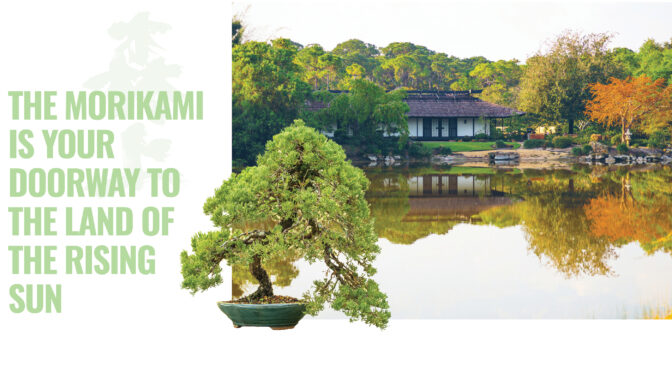
The Morikami Is Your Doorway To The Land Of The Rising Sun
By Sally Shorr
At the Morikami Museum and Japanese Gardens, art, history, nature, cuisine and culture come together in one of Palm Beach County’s most distinctive destinations.
This transportive cultural experiences awaits just west of Delray Beach’s palm-fringed beaches and hospitality heartbeat. At the Morikami Museum and Japanese Gardens, serenity and verdant natural surroundings sustain an evocative link to the Land of the Rising Sun, where visitors stroll past dew-soaked gardens hedged with ancient stone lanterns, and wood bridges hover above lush koi-filled ponds.
Founded as a cultural and educational center honoring the legacy of the Yamato Colony, Morikami tells a story that is both global and deeply local. In the early 1900s, a group of young Japanese farmers led by Jo Sakai established the Yamato Colony in northern Boca Raton, hoping to introduce innovative farming practices to Florida. George Morikami, a native of Miyazu, Japan, and one of the colony’s settlers, later helped transform that history into a lasting cultural bridge between Japan and Palm Beach County.
Today, Morikami continues that legacy through its mission to present Japanese cultural experiences that educate and inspire. The campus features traditional Japanese architecture, three exhibition galleries, a theater, an authentic tea house, classrooms, a museum store, the Cornell Café, lakeside terraces and 16 acres of Japanese gardens.
For many visitors, the gardens are the heart of the experience. Known as Roji-en: Garden of the Drops of Dew, the gardens were designed as a living extension of the museum. Created by garden designer Hoichi Kurisu, Roji-en is composed of six distinct gardens inspired by significant historical periods and styles of Japanese garden design. Rather than serving as replicas, the gardens are conceived in the spirit of Japan’s garden masters, offering a contemplative journey through landscape, water, stone, plantings, bridges and shifting views.
That sense of movement is part of what makes Morikami so resonant. The gardens invite visitors to slow down, pause and experience Japanese culture through nature and design. Families may come to explore the paths and koi, garden lovers may linger over the plantings and bonsai, and solo visitors may find a place for reflection. For groups, schools and cultural travelers, the museum and gardens together offer a meaningful introduction to Japanese history, art and aesthetics without leaving Palm Beach County.
Inside the museum, rotating exhibitions explore the arts and humanities of Japan through objects, images, textiles and stories. For visitors, one of the most compelling exhibitions is Threads of Silver & Gold, on view through Sept. 20. The exhibition focuses on uchikake, elaborately decorated outer robes that date to the Edo period, when high-ranking women wore them at court and brides in samurai families wore them for weddings. Their rich colors, raised silk weaving, padded hems and symbolic motifs, including cranes, turtles and cherry blossoms, offer a striking look at status, ceremony, craftsmanship and good-fortune imagery in Japanese textile traditions.
Museum guests can also experience two traveling exhibitions on view now through Aug. 30.
Yōkai: Scenes of the Supernatural in Japanese Woodblock Prints explores mysterious creatures, shape-shifting animals, vengeful ghosts, demons and other supernatural figures that have inhabited Japan’s folklore, theater, literature and visual culture for centuries. The exhibition includes 90 works, including woodblock prints and printed books spanning more than 250 years, with imagery that connects historic Japanese folklore to the visual language that continues to inspire manga and anime today.
Also on view is Courage & Compassion: Our Shared Story of the Japanese American World War II Experience, which examines the forced removal and incarceration of Japanese Americans during and after World War II. Through images, audio and interactive elements, the exhibition offers a 360-degree perspective on a difficult chapter of American history while honoring those who stood up for Japanese Americans as friends, neighbors and fellow citizens.
Morikami’s programming expands the experience far beyond the galleries. Visitors can take classes and workshops in Japanese cultural arts, from ikebana and bonsai to taiko drumming and tea ceremony.
Ikebana, the Japanese art of flower arranging, is offered through different schools of study. The Ikenobo School dates back to the 15th century and is considered the oldest and most traditional school, while Sogetsu takes a more contemporary approach centered on creativity and individuality, with the idea that ikebana can be practiced by anyone, anywhere, with almost anything. In both, students create arrangements to take home, making the class both cultural instruction and hands-on artmaking.
Bonsai classes offer another way to understand the patience and discipline embedded in Japanese aesthetics. Students learn to trim and train trees in containers, creating the illusion of age, maturity and nature in miniature. Morikami offers both beginner and intermediate classes, allowing guests to approach bonsai as an art form, a horticultural practice and a meditative discipline.
For those drawn to music and movement, taiko classes introduce students to Japanese drumming. Taiko can refer to the drum itself, a drumming style, a drum group or drum music, and Morikami’s classes give participants the opportunity to learn the history, culture and techniques behind the instrument.
The museum’s Sunset Strolls also bring the gardens to life after hours with live taiko performances by Fushu Daiko, along with koto performances and cultural programming. On Sept. 17, the Sunset Stroll theme is Japanese Fashion & Cosplay, with a cosplay fashion show hosted by Florida Supercon, offering a lively connection between traditional Japanese culture and contemporary pop culture.
The tea house is one of Morikami’s most distinctive cultural offerings. Seishin-an, the museum’s authentic tea house, allows visitors to observe or study sado, commonly known as the Japanese tea ceremony or “the way of tea.” While tea culture in Japan developed over many centuries, the form most closely associated with today’s tea ceremony was shaped in the 16th century by the influential tea master Sen no Rikyū, who elevated the practice into an art centered on simplicity, hospitality, mindfulness and seasonal awareness. At Morikami, tea ceremony classes are offered in the Omote-Senke style, and students learn in the tea house under instructor Yoshiko Hardick. The experience is never static. The tea ceremony changes from month to month and season to season, making each gathering a reflection of time, place and intention.
Family programs are also forefront to Morikami’s appeal. Craft activities, cultural celebrations, seasonal programs and youth camps invite children to encounter Japanese culture in accessible ways. A child might first experience Morikami by creating a Tanabata-inspired craft, listening to a story, attending a family program or walking through the gardens. For older children and teens, programs such as taiko and cultural workshops can turn curiosity into deeper engagement.
For visitors who want to complete the experience with cuisine, Cornell Café offers Pan-Asian-inspired dining overlooking the gardens. Menu offerings include bento boxes, teriyaki salmon, teriyaki chicken, cellophane noodles, vegetarian selections, sushi rolls, dumplings, edamame and other dishes that make the café a natural extension of the museum’s cultural mission. It is a place where a visit can become a full afternoon, moving from gallery to garden to table.
Morikami is also an important philanthropic and educational resource. Contributions and memberships help support exhibitions, educational programs, lectures, demonstrations, and the specialized training and maintenance required to preserve the Japanese gardens. Donations help ensure that visitors encounter world-class exhibitions, the gardens remain carefully conserved, children benefit from programs and communities continue to experience the beauty and connection that Morikami offers.
Morikami is both a destination and a historical reminder of the cultural depth available throughout Palm Beach County. It is a place for families, students, art lovers, garden enthusiasts, food lovers, history seekers and anyone interested in experiencing Japan through a South Florida lens. Whether visiting for a garden stroll, special exhibition, classes and workshops, or a delicious lunch at Cornell Café, Morikami offers a thoughtful and transportive experience rooted in beauty, education and cultural connection.
The Morikami Museum and Japanese Gardens is located at 4000 Morikami Park Road in Delray Beach. The museum and gardens are open Tuesday through Sunday from 10 a.m. to 5 p.m. The Cornell Café is open Tuesday through Sunday from 11 a.m. to 3 p.m. The museum is closed on Mondays and major holidays. For tickets, memberships, donations, upcoming exhibitions, programs and visitor information, visit www.morikami.org.


