Category Archives: Wellington Education

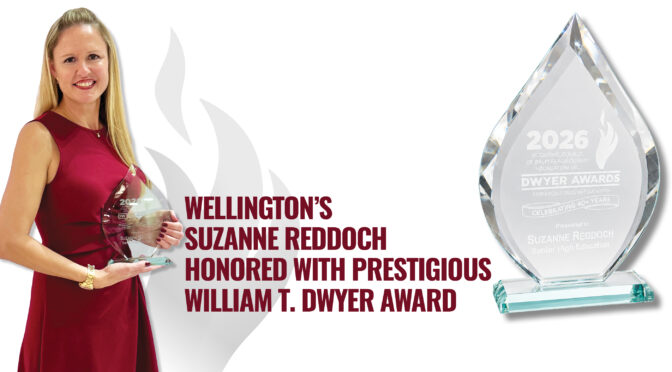
Wellington’s Suzanne Reddoch Honored With Prestigious William T. Dwyer Award

Wellington’s Suzanne Reddoch Honored With Prestigious William T. Dwyer Award

By Fiona Slusarev

Wellington High School’s Suzanne Reddoch, an AP statistics teacher who exudes warmth and genuine care, was honored at this year’s prestigious William T. Dwyer Awards for Excellence in Education. Reddoch won the Senior High Education category at the awards, presented May 4 at the Kravis Center for the Performing Arts.

The Dwyer Awards are an annual program that celebrates the hard work and commitment of accomplished educators in Palm Beach County. Established more than 40 years ago, the program starts with hundreds of nominations, which are narrowed down to 28 finalists from across the county. Then, one winner is selected for each of seven award categories.

The awards, created and run by the Economic Council of Palm Beach County Foundation, a nonprofit organization that strives to bolster collaboration between private and public sectors in the county, are decided by a panel of judges made up of almost 100 local business leaders.

Reddoch was completely shocked by her win. It was both her first nomination for and first win of a Dwyer Award — an uncommon combination. She described the awards as the teaching equivalent of winning an Oscar or Emmy.

She was nominated by her fellow faculty at WHS and then made it to the final four contenders for Senior High Education after an extensive screening process by the judges.

“It’s one of the most prestigious awards you can receive in my career. To even be nominated by my staff, and to make it to the final four, was unbelievable,” Reddoch said.

After she was nominated, Reddoch had to write a series of essays and obtain a letter of recommendation from WHS Principal Cara Gorham. She went a step further by including another optional letter of recommendation from the 2025 valedictorian.

Reddoch wrote a total of three essays that explained her personal teaching philosophy, her leadership roles within the school, and her involvement in the community in and out of the classroom.

Then, Reddoch had to be interviewed by the judges’ panel. They were particularly impressed that she records every lesson she teaches and posts the videos online for students to access. For students who are absent or simply need a rewatch to better understand a topic, these recordings are invaluable.

“I’ll record it. You can see my notes, everything — everything I project, my graphing calculator, how to do certain keystrokes,” Reddoch detailed.

The judges also admired how willing she was to step up and help the school community. From being an extra hand at lunch and chaperoning prom to helping a new basketball coach with behind-the-scenes work, Reddoch continuously goes the extra mile to support the WHS faculty, staff and, of course, the students.

“At the end, one of the judges just thanked me for how much I care about the kids,” Reddoch said. “I don’t remember his exact words because I got a little emotional, but I guess they could tell how much I care about [the students].”

You only need to listen to Reddoch speak about her students for a few minutes to understand why she won the award. From the thank-you notes her graduating seniors leave for her to the stories of the students she is still in contact with 14 years after graduation, her compassion for and dedication to her students is easy to see.

Before her current 22-year-long career as a math teacher, Reddoch was a seven-year-old who caught the teaching bug from her second-grade teacher. After her seventh-grade math teacher’s suggestion that she help her classmates with their work, Reddoch focused on a goal to teach math.

The relationship with her students is what keeps Reddoch coming back every year. Her classroom walls are lined with photos of each class she has taught since she began in 2004. She makes every student a personalized birthday sign and highlights the highest-scoring students with her Stars of the Week.

“They see how much I care,” Reddoch said of her students. “I get that a lot in notes they’ll write me at the end of the year on how much I truly care about them — and I care about them as a person, not just doing well in the class. I actually care who they are.”

She aims to be a safe adult that students can trust and come to in times of need, not just for academic guidance. Reddoch has an endless list of stories about how her students not only rely on her but also simply want to share good news with her. She’s heard everything from a student excitedly telling her how they went skydiving for their 18th birthday, to students crediting her for unknowingly convincing them not to drop out.

As much as Reddoch impacts her students, the experiences with her students also stay with her. “It’s always hard saying goodbye,” Reddoch explained. “You create these relationships with these kids, and you’re with them all year long. I’ve always gotten to know them, and they always talk about all different things with me — and the last day you’ve got to say goodbye.”

When Reddoch is not giving her all to her students, this lifelong Wellington resident unwinds by doing some yard work or photography, supporting her eldest son, a student at WHS, in travel baseball, and cheering-on her youngest son in soccer.

To learn more about the Dwyer Awards, visit www.economiccouncilpbc.org/dwyer-awards.

Facebookpinterestmail

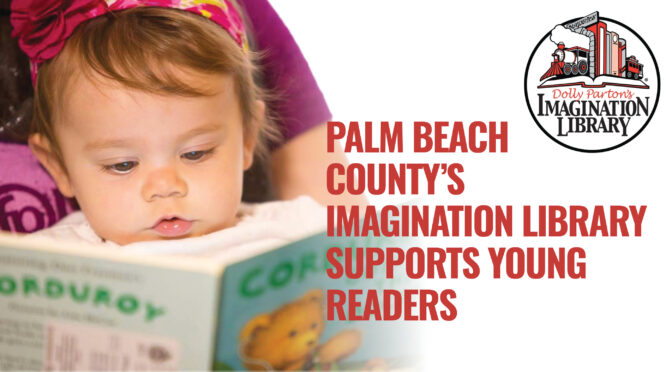
Palm Beach County’s Imagination Library Supports Young Readers

Palm Beach County’s Imagination Library Supports Young Readers

By Dean Glorioso

For more than 30 years, iconic American singer, songwriter and philanthropist Dolly Parton has been making the world a better place, one child and one book at a time.

Launching the Imagination Library in 1995, Dolly Parton and The Dollywood Foundation have been delivering books to children from birth to age five. Receiving one book per month, each child is treated to 60 stories that spark creativity and curiosity with adventurous tales, exciting characters and a few good lessons for their young lives.

Initially benefiting children in Parton’s home county in East Tennessee, the Imagination Library is now found across the United States, the United Kingdom, Australia and Canada, serving children and communities through the gift of reading.

Since 2020, the Palm Beach County community has had a local Imagination Library program partner, thanks to the vision of Christen Thompson.

“I’m always excited for people to learn about the Imagination Library, a wonderful program that truly starts a lifelong love of reading for kids and families,” Christen said. “All they have to do is register, and the books arrive in the mail addressed to the children, which they find so exciting.”

The daughter of a reading teacher, Christen, along with her husband Nicholas, who serves as chair, formed a nonprofit to partner with the Imagination Library and the Dollywood Foundation, which provides resources and guidance for parents.

“We can’t do it alone. An important goal is to make the Imagination Library better known throughout the community, expand its reach, and connect with business and community leaders,” Christen said.

Sponsorships, partnerships and fundraising efforts are helping to support the program, especially through its annual signature event, the Run for Reading 5K at Royal Palm Beach Commons Park, which returns this year on Saturday, Nov. 7. A fun family event that serves a great purpose, the 5K welcomes individuals, teams and sponsors, with all proceeds going to the Palm Beach County Imagination Library.

The event raises crucial money for the local nonprofit and helps grow its membership.

“Our cost is $2.60 for each book we send — a small price to pay for the love of reading,” Christen said. “And, since we started, we’re thrilled to have distributed more than 35,000 books to more than 2,000 local families.”

Those 35,000 books may be doing more good than most people imagine. The Literacy Coalition of Palm Beach County reports that 22 percent of community adults lack basic literacy skills. Furthermore, data from Palm Beach County schools indicates that 46 percent of students from grades three to 10 are performing below grade level.

A research study conducted by the Imagination Library shows that children enrolled in the program, when compared to those not enrolled, are four times more likely to demonstrate stronger literary skills, nine times more likely to listen to storytelling at home and 15 times more likely to participate in reading activities.

There is an expression in K-12 education that up until third grade, kids learn to read. After third grade, they read to learn. The Imagination Library’s efforts in this vital area of childhood development are helping to ensure learning and literacy.

“Putting books in kids’ hands not only instills a love for reading but also strengthens literacy, which can lead to greater success in school and even higher graduation rates,” Christen said. “Ultimately, it’s a path to post-secondary education and careers that contribute to the well-being and prosperity of the community.”

That path is paved with the Imagination Library’s generosity, initially supplying books for all newborns at the hospital where Dolly Parton was born. Today, families still receive that same first book, The Little Engine That Could, a tradition that Christen admires.

“What Dolly Parton has created is incredible,” she said. “It’s a special, lasting impact on children and families with each book. The last one comes with a certificate of completion and a video message from Dolly herself.”

Christen’s goal is to expand the Imagination Library and reach more families, encouraging them to join a program that provides books now and brings benefits for life.

“We are a county of diverse communities,” she said. “The Imagination Library may be a catalyst for enhancing the lives of kids and adults and an entire culture.”

Christen and Nicholas Thompson continually seek sponsorships and partnerships to help sustain the Imagination Library. Avid readers and parents of two boys, they both attended Marjory Stoneman Douglas High School in Parkland, inspired to serve in a meaningful way that gives back and pays forward for the future.

Driven by a passion for education, they are investing in the next generation, empowering young people through the wonder and joy of storytelling.

“To create a dream, you have to start somewhere, and this one begins by reading with imagination,” Christen said.

Local families are invited to sign up for the Imagination Library. Only certain areas can use the online form. All others should download, print and send in the registration form or send an e-mail.

To learn more about the Palm Beach County Imagination Library, e-mail info@palmbeachcountyimaginationlibrary.com, call (561) 975-5526 or visit www.palmbeachcountyimaginationlibrary.com.

Facebookpinterestmail

An Education At The NRI Institute Changes Lives

An Education At The NRI Institute Changes Lives

By Fiona Slusarev

The NRI Institute of Health Sciences is dedicated to creating educated and prepared health professionals devoted to caring for their community. Since 2015, the school has been providing nursing and sonography students an exemplary education with top-notch academic and career support. The school has campuses in Wellington and Royal Palm Beach.

Daniel Splain, NRI’s chief administration officer, has a lifetime of experience working in healthcare administration and insurance. His wife, Elizabeth Stolkowski, the president and director of the nursing education program, has had an impressively varied and lengthy career in nursing, as well as healthcare administration. Through NRI, they aim to give back to the healthcare community they have long been a part of and to bring more young people into the profession.

The United States is in the midst of a nurse shortage, according to the American Association of Colleges of Nursing. Nursing and sonography careers alike have become stable and high-paying choices. The degrees, clinical experience, support and guidance given at NRI set up healthcare students to succeed in their careers.

“Once they have that nursing license, with the constant shortage of nurses that we have in this country today, they are set for life. They will always have a job if they want it,” Splain explained.

NRI offers an associate’s degree of applied science in diagnostic medical sonography and an associate’s degree of science in nursing, with a new cardiac sonography diploma now offered. The institute is licensed by the Commission for Independent Education, approved by the Florida Board of Nursing, and accredited by the Council on Occupational Education.

Graduates of the sonography program are eligible for jobs in hospitals, doctor’s offices, radiology centers and independent diagnostic imaging centers. Nursing graduates are prepared for and qualified to apply for the NCLEX-RN Exam to become registered nurses. Both programs take between 18 to 24 months to complete.

There are two nursing tracks: the concept-based program of study and the advanced placement licensed practical nurse track. The former teaches concepts on a critical thinking basis and focuses on students’ ability to diagnose, readying graduates for real-world situations. The advanced placement track is for students who have already passed the NCLEX-PN and are licensed practical nurses.

Students get access to an academic library, designated study areas and laboratory facilities. The dedicated instructors take extra time to hold tutoring sessions, one-on-one career counseling and placement services. An extensive amount of time is devoted to preparing nursing students to sit for the NCLEX exam and is built into the curriculum.

“One of our specialties is preparing students for the NCLEX exam,” Splain said.

Students come to the NRI Institute for its flexible and unique approach to education. They are able to structure classes around their schedules either during the day or at night and on the weekends. Students who work or have family obligations can tailor their education to their lives.

“Our student base is largely nontraditional,” Splain explained. “It’s not people, for the most part, coming immediately from high school to higher education. Many have been out in the workforce. Many have families. And many of our students are first-time higher education graduates in their family.”

Academics are further personalized because the program is intentionally kept small. Class sizes are small, with an average of 10 to 20 students per instructor. With class sizes like this, students can foster close relationships with instructors, and learning is individualized. Splain noted that for some students, English is a second language. Teachers understand this challenge and work with students to help them achieve their goals.

According to Splain, what sets NRI apart from other institutions is “the level of personalized care that we give to each student. We assess what their needs are.”

With this approach to education, it’s not hard to understand why among NRI students, there is a 100 percent employment rate for sonography graduates and an impressive 83 percent passing rate for the NCLEX exam — higher than the average passing rate for colleges in Florida.

Additionally, education is made affordable through scholarships. Since the school is an accredited institute, students can apply for Title IV Federal Financial Aid Funding. NRI also accepts Florida Bright Futures Grants, Florida Student Assistance Grants, veteran benefits and other independent scholarships. The average student is assisted with 82 percent of the tuition cost.

“Nursing, and sonography as well, are two of the very few professions where a person can graduate and within the first year of employment actually make more money than their education costs them,” Splain said.

According to Splain, the biggest accomplishment that the NRI Institute has achieved is giving students a life-changing education that they can then use to change the lives of so many others. The majority of graduates stay and work in Palm Beach County, providing a vital service for residents and helping people when they need it most.

“We say the world is their oyster, and this education gives them a chance to crack open that shell,” Splain said.

For more information about the NRI Institute of Health Sciences, visit www.nriinstitute.edu.

Facebookpinterestmail

Stephen Ross And Palm Beach State College Investing In The Future

Stephen Ross And Palm Beach State College Investing In The Future

Story By Dean Glorioso | Photos By Carol Mcdonald

There is a popular expression in today’s educational culture that tells us to “Think Globally, Act Locally.” Visionary developer Stephen M. Ross is doing just that through philanthropy, mixed-use development and initiatives for innovative education.

In 2013, Ross, chairman of Related Ross, pledged to give more than half of his estate to philanthropic causes and charitable organizations through the Giving Pledge, a long-term worldwide initiative created by Warren Buffett and Bill and Melinda Gates that aims to inspire deeper engagement in philanthropy and increase charitable giving globally. In Palm Beach County, Ross has made a generous commitment of more than $8 million in scholarship funding to Palm Beach State College through the Stephen M. Ross Emerging Scholars Program.

This transformational gift comes to the Foundation for Palm Beach State College with the concurrent launch of Related Ross’ nonprofit Related Together, a private grant-making foundation. Funding projects that foster change and economic growth, Related Together is driving economic mobility in West Palm Beach’s northwest neighborhoods, including Historic Northwest, Pleasant City and Coleman Park. Moreover, Emerging Scholars is the nonprofit’s first educational initiative and complements the RISE Coleman Park initiative, addressing the housing, education, employment and health needs of individuals and families since 2021.

In June, Ross joined Palm Beach State College President Ava L. Parker, J.D., to speak with 275 middle and high school students at Palm Beach Lakes High School to celebrate the Stephen M. Ross Emerging Scholars Early College Summer Academy.

Having completed the program, these students are now eligible to apply for dual enrollment, pass a placement test and receive a full scholarship to Palm Beach State College, thanks to Ross and the Emerging Scholars initiative.

Ross told students that it’s advantageous for them to remain local after they graduate.

“You won’t find another place today that is growing like Palm Beach County with the potential to become the most important county in this country,” he explained.

Supporting underserved students through three key areas, Emerging Scholars is guiding young people to post-secondary education and credentials, ensuring a college-to-career pipeline that empowers students’ economic mobility and bolsters Palm Beach County’s future workforce.

Scholarships are providing opportunities for students from middle schoolers to high school seniors to complete their academic journey with the promise of tuition-free college diplomas and certifications.

Through dual enrollment and mentorships, the Early College Academy gives students head-start access to STEM (science, technology, engineering and math), health sciences and other high-demand career pathways.

Meanwhile, the Embedded Advisory program enables advisors to work closely with school counselors, who mentor students through their academics and critical years of development.

One of the largest in Palm Beach State College’s 92-year history, the gift from Ross is a testament to the belief he has in not only the college but also the community. The gift announcement came at Gaines Park, where West Palm Beach Mayor Keith James joined Parker to share their praise and appreciation.

“Mr. Ross’ gift is a beacon of prosperity and represents an exemplary collaboration between Related Together and Palm Beach State, contributing to our community with opportunities of inclusive growth for all,” James said with his wide, signature smile.

With typical passion in her voice, Parker spoke about Emerging Scholars removing barriers to postsecondary education.

“Together, we are investing in our young people with early college programs and expanding a qualified workforce for businesses to thrive right here in Palm Beach County,” she said.

Ross agreed. “We have the capacity and resources in our community to offer a gift that never stops giving — the education of our students,” he said. “West Palm Beach is a unique environment for growth, ready to become a model city for this country.”

As the chairman and founder of Related Ross, a fully integrated real estate firm with enormous expertise in mixed-use development, Ross has been leading the transformation of West Palm Beach for more than 25 years.

Related Ross’ latest project is the newly proposed multi-million-dollar, mixed-use K-Park development in Wellington. Recently approved by the Village of Wellington, this 70-acre development is a collaboration between West Palm Beach-based developer Related Ross and private school operator ElevateEd. Located near State Road 7 and Stribling Way, the K-Park project will create a dynamic residential and retail hub for Wellington and the nearby communities.

Consisting of two coordinated components, the project brings Related Ross’ residential, hotel, retail and dining offerings, as well as ElevateEd’s K-12 nonprofit private school, the New School Wellington. Led by Karen Yung, founder of ElevateEd and co-founder of Education in Motion, the school marks the organization’s first U.S. campus, with 14 currently operating worldwide.

Wellington Mayor Michael Napoleone has emphasized how beneficial the school is for the area. “Wellington is a private school desert, so this would be the first, and a great value for our community,” he said.

With a mission to shape tomorrow’s world, the New School complements what Palm Beach State College has been doing for more than 90 years — transforming lives through higher learning. In the end, both schools reflect the spirit of Related Ross and Stephen M. Ross’ vision for the community, empowering young people through innovative education and impacting neighborhoods with groundbreaking initiatives by investing in the future of Palm Beach County.

Learn more about Palm Beach State College at www.pbsc.edu and Related Ross at www.relatedross.com.


Facebookpinterestmail

Gap Year To College Freshman

Gap Year To College Freshman
Heading Back To School With Help From Palm Beach State College

By Christina Charles

As I walked off the graduation stage in May 2023, I couldn’t shake this feeling of internal dread about the future. Despite my peers’ happy faces and their families’ enthusiasm about their upcoming move-in days, the rest of my year would include months of sheets with my punch-in and punch-out times. I smiled for the cameras, went home and got ready for work the next day.

I had pondered my entire senior year about what I wanted to do for “the rest of my life,” and by graduation, I still didn’t have an answer. I decided to take a gap year. I imagined my old schoolmates graduating together and going on to become lawyers, doctors and other useful members of society, while I’d be stuck finishing whatever degree I decided to do.

Yet as stressful as my situation was, it ended up being a year devoted to not only saving toward college, but gaining life skills that I knew would pay off once I got enrolled. As my gap year was ending, I was beaming with excitement at the thought of all the knowledge I would earn going back to school. I have gained a positive work ethic, a solid schedule and a clear headspace, and all that was left was my education.

Picking which school I was enrolling in was a no-brainer — Palm Beach State College at the Loxahatchee Groves campus was it. It was so simple to schedule a tour online and could hardly contain myself as my tour date approached. Finding the Loxahatchee Groves campus was extremely easy, and the directional signs made it a breeze to meet the campus recruiter.

What seemed like one the scariest times in my life turned out to be one of the most welcoming experiences I have ever faced. As I opened the door to the clean and air-conditioned building and walked up to the student assistant, who helped check me into the office, I was greeted with hellos and warm smiles from the friendly office associates, both the students and the staff. It wasn’t too long after I had checked in that Stankeisha Burchell-Webb, outreach program specialist for Palm Beach State College, appeared. She introduced herself and told me to have a seat while she prepared for the tour.

After sitting, I nervously picked up every pamphlet I saw to get an idea of what I had to look forward to. It was all I could do to contain myself as my leg shook furiously from excitement. I looked at all the majors that were presented before me. PBSC offers 130-plus programs of study, including business, arts and communication, industry manufacturing, construction and transportation, public safety, STEM programs and more. My head started spinning at the thought of me getting my associate’s degree, bachelor’s degree and perhaps even a master’s degree in any of these fields. There are also options of getting certificates in a trade that can help me get into the workforce faster. Could I really do that at this point?

Before I thought too hard, my name was called, and I sprang to my feet. Ms. Burchell-Webb shook my hand and looked as if she was more excited than I was. We walked out of the front office as she showed me where I’d be taking summer classes, along with the other classrooms up ahead. The atmosphere was relaxed and welcoming, with the sunlight beaming into the modernly designed lounge areas. It contrasted with the image I had in my head of a stressful and fast-paced environment. I was in awe of the wide-open space. The campus had several seating areas that allowed students to have both down time and/or study sessions. There were computers and books that you could borrow or work on.

I was in awe of everything I saw. Looking into this institution, I envisioned myself working on assignments that would push me further to graduation and couldn’t help but be thrilled at the thought. I imagined all the connections and internships I’d do to build my portfolio. This is where I would find myself! Not only do they have a wide variety of classes to enroll in, but they have celebratory events, clubs and performing art shows that enhance the college experience through making friends and connections in personal interests. I had already found myself being interested in clubs such as the Black Student Union, the Anime Club and the Math Club.

Toward the end of the tour, we stopped at the Student Learning Center, where students and supervisors worked together to explain the areas of studies where tutoring was offered for free. They offered a plethora of subjects, such as accounting, writing, math and even technology/programming. You have the option of scheduling an in-person or online tutoring session. This demonstrates the accommodations that PBSC makes for students. They explained the proficiency in optional tutoring, even if you felt confident in the subject area; the extra help to master the content that would push you ahead in your classes. I recognized the staff’s desire to help students succeed, and it gave me a sense of comfort knowing that my academic needs would be met for my learning style.

Returning to the main office, I met with Armando Carrasco, the student development advisor, who went over in-depth all the classes I would need to get my associate’s degree. He presented Palm Beach State College’s transfer program to move to another university after completing your associate’s degree. He explained the optional part-time or full-time classes, and the option to learn on campus or remotely. There were so many positive options on where I could take my education that it was overwhelming.

Nearing the end of my visit, I sat with the financial aid advisor, Effie Scott-Jackson, to sort out my financial circumstances. In a typically vulnerable space, she greeted me into her office and empathically allowed me to explain my situation. She asked me about my ambitions and interests. My mind was spinning again, but this time with excitement to give my answers. She took her time to describe the best possible route to financially take care of my class requirements.

Tuition at Palm Beach State College is surprisingly affordable. Ms. Scott-Jackson explained all the resources I could exhaust to pay for my classes. This included scholarships, grants and loans that could give me the extra leverage to afford my education. She emphasized to reach out again if I’m in need of anything, that the administrators were there to make sure I was successful. This made choosing classes a less stressful process.

After a hectic and confusing gap year, it was pleasant to come to an institution that allowed me to move at my own pace and ensure my prosperity. A few months after my tour of the campus, I am now a freshman at Palm Beach State College studying for my associate’s degree and looking forward to pursuing a degree in cybersecurity and technological advancement. I look forward to my future at PBSC, and I am confident in my ability to do well at school and create a strong foundation to excel in the workforce.

Palm Beach State College’s Loxahatchee Groves campus is located at 15845 Southern Blvd. Learn more about programs at www.palmbeachstate.edu.

Facebookpinterestmail

Empowering Students To Become Their Best Selves

Empowering Students To Become Their Best Selves
The Wellington Collegiate Academy Is A Faith-Based Private School Celebrated For Academic Excellence

Story and photos by Christina Charles

Nestled in the heart of Wellington, the Wellington Collegiate Academy (WCA) is a beacon of education, dedicated to molding hardworking, respectable and self-reliant students.

This K-8, faith-based private school is celebrated for its academic excellence and its dedication to instilling the enduring philosophy of Stoicism, highlighting four cardinal virtues: justice, wisdom, temperance and courage. These timeless values permeate throughout the school community and are seamlessly woven into the fabric of everyday school life.

Each day at WCA begins with a tradition that sets the tone for the students. The morning prayer, a moment of reflection and gratitude, instills peace and purpose. This is followed by a mini assembly that reinforces accountability, fostering transparency and mutual respect within the school community. Leading this assembly are owners Horatio and Yaa McFarlane, a dynamic duo whose words transcend mere motivation.

Drawing from decades of educational experience, they provide wisdom and practical advice rooted in their professional backgrounds and personal journeys.

“At Wellington Collegiate Academy, Stoic values are not just theoretical concepts, but are actively embraced by the students,” Horatio McFarlane said. “Virtues such as temperance, wisdom, justice and courage are interwoven into daily school activities, shaping the character and responsibility of each student. The emphasis on hard work and self-reliance extends beyond academics to extracurricular activities.”

WCA students understand that their efforts directly impact their success, both in and out of the classroom. The McFarlanes envision a holistic education that nurtures the body, mind and soul. Physical health is prioritized through daily fitness programs, teaching teamwork and perseverance. Mental and emotional well-being receive equal attention. Psychology classes explore brain function and human behavior, while art classes provide therapeutic outlets for creative expression. The school employs the faith-based Abeka curriculum, emphasizing love and kindness.

“This year, new curriculum enhancements include Ukrainian language classes alongside Spanish, with French introduced last year,” Yaa McFarlane said. “These courses foster cultural awareness and enhance cognitive skills, helping students recognize their true potential.”

One of the most distinguishing features of Wellington Collegiate Academy is its commitment to creating a safe and nurturing environment. The school’s dedicated teachers are not just educators but mentors who give the necessary attention to each individual child. Their genuine care and personalized approach ensure that every student feels valued and supported.

WCA offers students and their families a strong sense of community. Students, teachers and parents work together in harmony, creating a supportive network that extends beyond the school gates. This collaborative spirit is instrumental in fostering a positive and inclusive atmosphere. Central to its educational philosophy and embedded in the school crest are the four cardinal virtues, which serve as the moral compass guiding students on their journey toward becoming responsible, principled and resilient individuals. By embracing and embodying these virtues, students not only excel academically but also develop into compassionate and morally grounded individuals prepared to navigate life’s complexities with integrity.

“At Wellington Collegiate Academy, we believe that every child possesses a unique constellation of gifts, graciously bestowed upon them by God,” Yaa McFarlane said. “We strive to create an environment where these gifts are discovered, nurtured and celebrated as they shine brightly.”

At WCA, the teaching approach is tailored to each child’s learning style. Visual learners benefit from lessons projected in each classroom, while kinesthetic learners engage with hands-on activities and physical experiences. Auditory learners thrive through lectures, discussions and audio materials.

Under the leadership of the McFarlanes, who took over at the long-established school last year, the academy continues to innovate and excel, nurturing the body, mind and spirit of each student. To the McFarlanes, Wellington Collegiate Academy is more than just a school; it is a nurturing environment where students are empowered to become their best selves.

Through their core guiding principles, innovative curriculum enhancements and a dedicated teaching staff, the academy provides a holistic education that prepares students for the challenges of tomorrow. Discover the difference a value-driven education can make in shaping your child’s future.

The Wellington Collegiate Academy is located in the original Wellington Mall at 12794 W. Forest Hill Blvd., Suite 14B. To explore how your child can become a part of this unique community, contact the school via e-mail at info@gowca.org or call (561) 784-1776. Visit www.gowca.org to learn more.

Facebookpinterestmail

Higher Education For All

Higher Education For All
PBSC’s Ava Parker On Educating The Workforce Of Tomorrow

By Joshua Manning

Palm Beach State College President Ava L. Parker leads the largest institution of higher education in Palm Beach County. Under her leadership, the college has hit record enrollment levels and opened a fifth location, the fast-growing Loxahatchee Groves campus just across Southern Blvd. from Wellington.

“I am truly honored to serve as the fifth president of the college,” Parker said. “I chose Palm Beach State because of the difference that it has historically made in the lives of our students, their families and our community. We are a partnership institution and a critical part of the economic infrastructure.”

A Wellington resident, Parker holds a bachelor’s degree and a law degree from the University of Florida. She came to PBSC nine years ago from Florida Polytechnic University in Lakeland, where she served as executive vice president and chief operating officer.

“PBSC has the distinction of being the state’s first public community college, a legacy that underscores our commitment to providing an accessible, affordable, high-quality education that opens pathways to careers right here in Palm Beach County,” Parker said.

She is proud of the sense of community she sees in how the school’s faculty and staff work together to support more than 36,000 students.

“Our focus on innovation, coupled with our wide range of programs and resources, empowers students to achieve their career and life goals and make a meaningful impact in the communities of Palm Beach County,” Parker explained.

Looking for a centrally located home with easy access to PBSC’s five campuses — Boca Raton, Belle Glade, Lake Worth, Loxahatchee Groves and Palm Beach Gardens — Parker quickly settled on Wellington as her home base.

“I was looking for a family environment with good schools and friendly people and a place that was central to our college campuses,” Parker recalled, adding that people she spoke to often mentioned Wellington. “My husband Joe Gibbons and I were sold after our first visit. We rented here first just to be sure, and we eventually bought our home here in Wellington. It has been a great choice for us. My son Parker and daughter Bailey have enjoyed participating in recreational sports.”

Wellington also provides her family with a rich variety of family-oriented activities.

“The Wellington area is horse country, and one of the things I enjoy most is attending polo matches at the National Polo Center,” Parker said. “I also enjoy the parks and participating in holiday activities with my family. The Wellington Environmental Preserve offers a beautiful respite with its nature trails and scenes of wildlife, and the Mall at Wellington Green is always a go-to destination for shopping.”

A key focus of Parker’s tenure has been the opening and growth of the Loxahatchee Groves campus, designed to serve the central western part of Palm Beach County.

“The rapid growth of this area is reflected in the numbers of students enrolling on our Loxahatchee Groves campus,” Parker said. “We first opened the campus in 2017 with some 700 students. This year, more than 6,000 enrolled on this campus alone, making Loxahatchee Groves the fastest growing of PBSC’s five campuses.”

A key reason for that success is the strong relationships that the college has built with the local community.

“We work directly with the four major high schools in the area: Wellington, Palm Beach Central, Royal Palm Beach and Seminole Ridge,” Parker said. “Beginning this fall, we will have advisors from PBSC embedded in all these high schools who help serve students and increase enrollment. We’re also meeting students much earlier in their academic careers, introducing students as young as sixth grade to the college experience through our dual-enrollment programs.”

PBSC also works closely with major employers in the area.

“We have partnerships with businesses such as Wellington Regional Medical Center, HCA Florida Palms West Hospital and Gast Construction Group, as well as with major employers such as Florida Power and Light,” Parker added. “Many of these partners hold educational events for our students and provide internships, as well as paid jobs.”

Parker and her team also make it a point to be active in the community.

“We regularly meet with the mayors of Wellington, Royal Palm Beach, Westlake and Loxahatchee Groves, as well as their council members and chambers of commerce,” she said. “We also have a 230-seat lecture hall at our Loxahatchee Groves campus, which has become a popular venue for hosting community educational programs, events and meetings.”

The college has made health science a primary focus in Loxahatchee Groves.

“In 2020, we established the Frank DiMino Center for Medical Innovation, enabling PBSC to expand our training programs in high-demand healthcare fields,” Parker said. “Our bachelor of science in nursing program is housed at the Loxahatchee Groves campus, and by fall 2025, we will also offer programs such as surgical technology, physical therapy and dental hygiene. We also offer computing and cybersecurity, and business and accounting programs at our Loxahatchee Groves campus.”

Currently under construction there is the $50 million, 83,500-square-foot Dental & Medical Services Technology Building. “It will feature a fully equipped dental clinic, a surgical technology suite, and science labs that incorporate cutting-edge equipment and technology for students pursuing careers as dental hygienists, dental assistants, surgical technologists and other healthcare occupations,” Parker said. “This new facility will offer virtual reality learning technology and a highly advanced 3D anatomy visualization and virtual dissection system for anatomy and physiology education.”

The building is set to be completed by February 2025, and classes will begin in the fall of 2025. The new building will benefit the local community as well by providing low-cost preventative dental care, Parker added.

Other initiatives include the creation of the Construction Trades Center for Workforce Innovation on the Lake Worth campus, which expands skilled trades programming with $5 million in federal funding plus $1 million from the Lowe’s Foundation. Both the Belle Glade and Loxahatchee Groves campuses have been tapped to expand training for first responders, and the Palm Beach Gardens campus will be key to a partnership with TMRW Sports. In cooperation with the PGA Tour, TMRW has selected PBSC as the exclusive home for TGL, its new professional indoor golf league that fuses advanced technology with live action for TV audiences.

“We see our mission as educating the future workforce of Palm Beach County,” Parker said. “Thanks to the strong partnerships we have with all the constituents in our community from local schools and the school district to industry, we are ensuring that our curriculum is relevant to the needs of our county. Our students power the engine of Palm Beach County’s economic growth in sectors ranging from healthcare to information technology to construction and engineering.”

Learn more about Palm Beach State College at www.palmbeachstate.edu.

Facebookpinterestmail

Public Schools Arrive In Wellington

Public Schools Arrive In Wellington
Wellington Elementary School Opened In 1980 As A Collection Of Portable Classrooms Under The Leadership Of The Legendary Buz Spooner

By Joshua Manning

Children in the fledgling community of Wellington were first bused east to attend school. However, after years of petitions, the School District of Palm Beach County opened Wellington Elementary School in 1980, led by the iconic Buz Spooner, the school’s founding principal.

Marketed as the perfect community for families, Wellington’s early days lacked one crucial element — schools.

Young kids were bused to Melaleuca Elementary School on Gun Club Road, while older kids made the long hike east to Forest Hill High School.

But all that began to change in 1980, when the School District of Palm Beach County opened Wellington’s first elementary school after years of petitions from area residents.

The school district owned a site at the corner of Big Blue Trace and Paddock Drive, but no building. So, when Wellington Elementary School opened in 1980, it consisted of 16 portables, with no kitchen and no cafeteria. The first PTA meeting was held at the old Wellington Country Club.

“The portables worked well, unless it was raining,” recalled the late Buz Spooner, the school’s founding principal, during a 2001 interview.

When it opened, the school had children from grades three, four and five, as well as one class for grade six. Kindergarten and grades one and two were first held at Greenacres Elementary School. Spooner had been the principal there before being assigned to become Wellington Elementary’s first principal.

“On my first visit to the school, I got lost,” Spooner recalled. “I was looking for a school, but I found a big sandy pasture.”

Spooner took over as principal during the 1979-80 school year. “It was a challenge,” he recalled. “There were a lot of glitches you wouldn’t expect. Each day, we had to look under the steps, because small animals nested there. We had raccoons and armadillos, but thankfully, nobody ever got bitten.”

During the 1982-83 school year, the students and staff of the fledgling school began moving into a permanent facility built at the site. “The kids got to attend the groundbreaking ceremony,” Spooner noted.

Spooner remained the principal of Wellington Elementary School until 1999, when he retired. He had been a part of the school system in Palm Beach County for 43 years, starting as a teacher at Greenacres Elementary School. But his fondest memories were of his two decades of service in Wellington. “I was able to help more children as a principal,” Spooner said. “By hiring the teachers, you can shape the kind of school you want to have.”

Spooner grew Wellington Elementary School from that cluster of portables to a full-fledged school that once taught up to 1,500 students per year as the school district raced to keep up with the area’s explosive growth.

Outside Wellington, Spooner was best known for his many years as president of the Palm Beach County Safety Patrol. It was in that role that he touched the lives of fifth graders countywide, working tirelessly to organize a massive movement of students from Palm Beach County to Washington, D.C., each year.

Spooner passed away in 2019, but he is still fondly remembered by many in Wellington.

Elaine Cittadino was Spooner’s executive assistant from the time the school opened for 16 years, before she moved to the after-school program. She recalled how Spooner often said he never wanted to do anything but work with elementary school students. “Right from the very beginning, Mr. Spooner created his school. He interviewed and hand selected everyone at that school,” she said.

Cittadino also recalled how he was very supportive of his teachers and used to say, “I always hired people who were smarter than me and let them do their jobs.” She added that one of his favorite sayings was, “They may forget what you taught them, but they will never forget how you treated them.”

Cathy West, who has been a teacher at the school since 1982 and currently serves as the media specialist, agreed that he was a “teachers first” principal. “Each year, he would meet with the grade level teachers and make sure they were all on the same page,” he said. “He always had an open-door policy.”

Sue Bierer was a fifth-grade teacher at the school from 1985 until her retirement in 2012.

“Any time a teacher or a class had a special program, he was always really supportive of that,” said Bierer, who is excited that her granddaughter will be attending Wellington Elementary School as a kindergartener.

Cittadino has vivid memories of the school’s early years.

“We had 13 portables with grades three through five. Sixth grade also came in for a year,” she recalled about the school’s opening year. “We really spawned all the other schools in Wellington and beyond. H.L. Johnson started on our campus. There was lots of wildlife out there — foxes, snakes, armadillos. We were always very conscious of the environment and had many school cleanups.”

West recalled her first year working in a portable classroom that was also the school’s library, the speech teacher’s office and teacher’s lounge. There was a black indigo snake that lived under the portable. “Every so often, you would hear a scream because it startled someone,” she said.

Bierer added that the original campus often got waterlogged. “We would have to trudge through the water to get to where we were going,” she said.

Nevertheless, the fond memories outweigh the problems of the early years. “I remember all the fun we had,” Bierer said.

The three teachers are proud of how Wellington Elementary has matured through the years into the school it is today.

“We have a wonderful administration right now that tries to keep up with the traditions of the school,” West said, adding that the current administration building is dedicated to Spooner.

Cittadino is proud of the strong fine arts program at the school, and Bierer likes the new buildings on the campus, which she said are “very conducive to learning.” Bierer also loves the enthusiasm of the young teachers on the current campus.

Wellington would not get its next school until 1987, when Wellington Landings Middle School opened. Wellington High School and New Horizons Elementary School both opened in 1990, finally allowing all Wellington students to stay in the community for their entire public-school experience.

Since then, Wellington has been joined by another high school, two more middle schools and four more elementary schools — Panther Run Elementary School (1991), Binks Forest Elementary School (1999), Polo Park Middle School (2000), Palm Beach Central High School (2003), Equestrian Trails Elementary School (2003), Elbridge Gale Elementary School (2006) and Emerald Cove Middle School (2007).


Facebookpinterestmail

Recent Grads Are Ready To Serve

Recent Grads Are Ready To Serve Twins Ryan And Reid Snider Are Both Headed To National Military Service Academies

Story by Mike May  |  Photos by Frank Koester

Wellington’s Ryan and Reid Snider have the distinct and fairly rare honor of being twins both headed off to highly selective national military service academies.

For the last 18 years, Diana and Dan Snider of Wellington and their twin sons have lived a life where the boys attended the same public schools and usually participated in the same activities. Now, life is changing. The two boys will remain united as brothers, but Ryan and Reid have decided to divide and conquer, as a way of furthering their education while patriotically serving and defending the nation.

After graduating from Palm Beach Central High School on Friday, May 17 — where Ryan was class valedictorian and Reid was ranked 13th among his 735 peers — both boys became focused on the next chapter of their lives, which have existed in lockstep with one another since birth.

Both Ryan and Reid are ambitious, athletic, creative, patriotic, smart, talented and are college-bound, but now they are headed in differing directions. Ryan is heading west to the United States Air Force Academy in Colorado Springs, Colorado, while Reid is going north to the United States Military Academy in West Point, New York.

These ambitious young men from Wellington are not content to simply attend and graduate from their respective service academies. They want to excel and grow in their new environments.

“I will pursue a dual major in astronautical and aerospace engineering,” Ryan said. “My goal is to be a pilot and fly F22s, one of the most advanced stealth fighters in history. But I also want to use my experience and engineering knowledge to build the next generation of air and spacecraft.”

His brother also has an interest in engineering with big dreams.

“I plan to major in mechanical engineering with a specialization in astronautical engineering,” Reid said. “I am also interested in studying law and political science. In addition, I want to work with NASA, be an astronaut and go to Mars.”

The Snider boys will remain united as a family, but for the first time will be divided, geographically.

“We are always under the same sky with the same stars,” said Ryan, the older of the two boys by one minute, as both were born at the Wellington Regional Medical Center in December 2005.

The idea that both boys would pursue a military education and lifestyle is not a surprise, but it was not expected, either. “Two of the boys’ uncles served in the Air Force, their paternal grandfather was in the Army, and their paternal great-grandfather was in the Navy,” their mother Diana explained. “They, and we, are honored at the opportunity for each of our boys to be nominated and selected for these elite service academies.”

While Ryan and Reid are thrilled to be headed off to their service academies, they previously thought that their collegiate home would be in Gainesville, Florida.

“Our parents had done Florida Prepaid, and so our goal, before getting the service academy e-mails, was to get into the University of Florida,” Ryan said. “Throughout our application process to the service academies, we still applied to UF. But, crazy enough, UF was our backup school. In addition to our military appointments, both of us received our acceptance into UF.”

“I grew up as a huge Florida Gator fan, bleeding orange and blue,” added Reid, who was accepted into UF’s Honors College. “I always wanted to attend the University of Florida.”

Even though Ryan and Reid will be going their separate ways, they almost went to the same service academy. Soon after taking their PSAT as sophomores in high school, both boys received an informational e-mail from West Point.

“That stopped us in our tracks,” Diana recalled. “We talked about West Point and began looking up information on the other service academies. The boys became so interested that we took a family road trip to West Point in June 2022 following their sophomore year of high school. In August of that year, our family of four flew out to Colorado to visit the Air Force Academy.”

According to Diana, both boys researched and decided that they were interested in both West Point and the Air Force Academy. They applied for the summer leadership program at both academies and were accepted to both.

So, during the first week of June 2023, after their junior year at Palm Beach Central, they flew to West Point together for an intense week-long experience. They flew home at the end of the week, unpacked, washed clothes, repacked and flew to Colorado for another several days at the U.S. Air Force Academy’s program.

“We knew they would either love it or hate it,” Diana said.

Not surprisingly, they both loved the leadership programs, but Ryan preferred the Air Force Academy, while Reid really liked what was offered at West Point.

“Separately, they focused on their application packets, secured their nominations, and completed all necessary physical and academic requirements,” Diana added.

To get accepted into a military service academy, a current member of the U.S. House of Representatives or the U.S. Senate must also sign-off on your application.

For Ryan, U.S. Sen. Rick Scott approved his application, while U.S. Rep. Lois Frankel approved Reid’s paperwork.

Ryan will report to Colorado Springs on June 26, while Reid must report to West Point a few days later, on July 1.

Between now and then, Ryan and Reid will focus on improving their physical fitness. Both noted that their daily lives are now filled with running, lifting weights, and doing lots of calisthenics such as push-ups, pull-ups and sit-ups.

After graduating from the service academies, they are committed to a minimum of five years of active-duty service, followed by at least three years in the reserves, but both boys predict long careers with their respective military disciplines.

While both boys are excited about their immediate futures, they agree that they’ll miss the creature comforts of home, especially their mother’s cooking.

“I’m really going to miss mom’s really good quesadillas,” Ryan said.

“And I’m going to miss eating mom’s cakes, fudge and cookies,” Reid added.

Their parents know that life for them will be different, too.

“It will be very quiet,” Diana said. “But there will be many trips to both Colorado and New York for parents’ weekend, and other opportunities to spend time with our boys.”

Meanwhile, Diana knows that it’s time to let her sons pursue their dreams.

“We know that we have raised them to work hard, focus on their goals, add value to others and positively impact our world,” she said. “We trust that they are on track to do just that. We are honored to get to watch them continue to grow into amazing men.”

Facebookpinterestmail

Riding Toward Excellence

Riding Toward Excellence The Equestrian Program At American Heritage Provides A Unique Educational Experience

By Stephanie D. Concepción

Nestled amid the vibrant equestrian community in Palm Beach County, the Equestrian Program at American Heritage Schools (AHS) stands as a beacon of academic excellence and equestrian prestige.

Located just minutes from world-class equestrian facilities like the Wellington International showgrounds, the Global Dressage Festival grounds and the National Polo Center-Wellington, the school offers unparalleled access to premier riding venues.

The program, established in 2011, boasts award-winning riders who have consistently excelled, placing in the top five at Interscholastic Equestrian Association (IEA) competitions and ranking in the top 10 nationally. These talented equestrians have also performed internationally, such as representing the United States in the North American Youth Championships (NAYC), where they secured a top 10 placing.

This unique program offers a balance of academics and equestrian training for riders from kindergarten to college, inclusive of all grade levels.

Lower School students, from kindergarten through grade five, can enroll in the Junior Equestrian Program. Beginning in sixth grade, students can train at team barns.

This early engagement provides opportunities for after-school lessons at nationally recognized barns and training programs, fostering a love for riding from an early age. For students in grades seven through 12, AHS hosts two IEA teams that provide a competitive platform and foster a spirit of camaraderie and teamwork.

“We started with two students and now have over 35 families, several of which have come from other countries specifically for the program at American Heritage, as well as the experience of riding, training and competing in Wellington,” said Cynthia Screnci, director of the Equestrian Program, reflecting on the program’s growth and international appeal.

Students can pursue their equestrian goals at AHS while receiving a superior education. American Heritage offers six pre-professional programs in biomedical engineering, business, computer science, engineering, law and medicine. Each program is taught daily by professionals in their respective fields with unique classes that rival those of any Ivy League school.

Senior Sophia Masnikoff, a National Merit Semifinalist and a graduate of the school’s pre-law program, highlights these unique benefits.

“Going to a school like American Heritage fosters all aspects of my educational and athletic goals,” she said. “The school is rigorous, which fuels my passion for learning, while also accommodating my schedule, and my time as co-captain of the American Heritage Equestrian Team furthered my love of the sport; building teamwork skills used in everyday life. It provided me the platform to thrive in my riding and academics.”

Senior Anaïs Dufresne Powell, a graduate of the pre-medical program and also a National Merit Semifinalist, exemplifies the program’s success. Accepted into prestigious universities such as UCLA, Bryn Mawr and Wellesley College, Powell balances her academic excellence and award-winning photography pursuits with her passion for equestrian sports, showcasing the effectiveness of the school’s holistic approach.

American Heritage recognizes the unique demands placed on competitive equestrian athletes and offers flexible policies for equestrian-related absences. High school students can earn physical education credits based on their training schedule, further integrating their equestrian activities with their academic pursuits. The school day schedule accommodates academic and equestrian commitments, including free transportation to various barns in Wellington for training.

Mia Green, a junior who balances rigorous academics with her competitive riding schedule, emphasizes the school’s supportive environment.

“American Heritage teachers are very accommodating when it comes to giving us the ability to pursue both our equestrian goals and keeping up with academics,” she said.

Green’s dedication extends beyond her achievements. As one of the founders of Forget Me Not Farm’s Home for Peculiar Animals, a nonprofit animal rescue, she exemplifies the school’s emphasis on community service and leadership.

At American Heritage, young equestrians are not just athletes, they are scholars, leaders and compassionate individuals ready to make a mark on the world. By providing a superior college preparatory education alongside world-class equestrian opportunities, AHS ensures that its students are prepared for success, in the arena and beyond.

American Heritage Schools is ranked the No. 1 K-12 Private School in Florida, according to Niche.com, with two campuses in Broward and Palm Beach counties, serving approximately 4,800 students in PK3 through grade 12. AHS has ranked as the top high school in Florida for the highest number of National Merit Scholars for 14 years, as well as the top school in Florida for the most Presidential Scholars.

AHS campuses are open all year and provide an extensive Summer Program for children ages 3 to 17 from June to August. The offerings include traditional day camps, specialty and sports camps, one-on-one tutoring, and the Summer Institute offers more than 100 in-person and online courses designed for every student’s interest. The comprehensive summer enrichment gives students a competitive advantage to succeed in the next school year.

American Heritage Schools’ Palm Beach campus is located at 6200 Linton Blvd. Learn more about AHS’s unique Equestrian Program at www.ahschool.com/equestrian-program.

Facebookpinterestmail