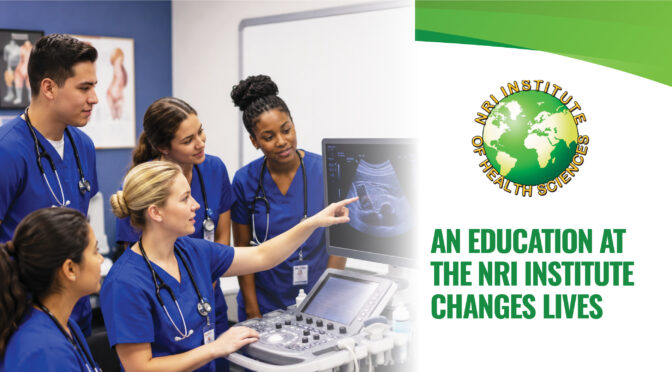
An Education At The NRI Institute Changes Lives
By Fiona Slusarev
The NRI Institute of Health Sciences is dedicated to creating educated and prepared health professionals devoted to caring for their community. Since 2015, the school has been providing nursing and sonography students an exemplary education with top-notch academic and career support. The school has campuses in Wellington and Royal Palm Beach.
Daniel Splain, NRI’s chief administration officer, has a lifetime of experience working in healthcare administration and insurance. His wife, Elizabeth Stolkowski, the president and director of the nursing education program, has had an impressively varied and lengthy career in nursing, as well as healthcare administration. Through NRI, they aim to give back to the healthcare community they have long been a part of and to bring more young people into the profession.
The United States is in the midst of a nurse shortage, according to the American Association of Colleges of Nursing. Nursing and sonography careers alike have become stable and high-paying choices. The degrees, clinical experience, support and guidance given at NRI set up healthcare students to succeed in their careers.
“Once they have that nursing license, with the constant shortage of nurses that we have in this country today, they are set for life. They will always have a job if they want it,” Splain explained.
NRI offers an associate’s degree of applied science in diagnostic medical sonography and an associate’s degree of science in nursing, with a new cardiac sonography diploma now offered. The institute is licensed by the Commission for Independent Education, approved by the Florida Board of Nursing, and accredited by the Council on Occupational Education.
Graduates of the sonography program are eligible for jobs in hospitals, doctor’s offices, radiology centers and independent diagnostic imaging centers. Nursing graduates are prepared for and qualified to apply for the NCLEX-RN Exam to become registered nurses. Both programs take between 18 to 24 months to complete.
There are two nursing tracks: the concept-based program of study and the advanced placement licensed practical nurse track. The former teaches concepts on a critical thinking basis and focuses on students’ ability to diagnose, readying graduates for real-world situations. The advanced placement track is for students who have already passed the NCLEX-PN and are licensed practical nurses.
Students get access to an academic library, designated study areas and laboratory facilities. The dedicated instructors take extra time to hold tutoring sessions, one-on-one career counseling and placement services. An extensive amount of time is devoted to preparing nursing students to sit for the NCLEX exam and is built into the curriculum.
“One of our specialties is preparing students for the NCLEX exam,” Splain said.
Students come to the NRI Institute for its flexible and unique approach to education. They are able to structure classes around their schedules either during the day or at night and on the weekends. Students who work or have family obligations can tailor their education to their lives.
“Our student base is largely nontraditional,” Splain explained. “It’s not people, for the most part, coming immediately from high school to higher education. Many have been out in the workforce. Many have families. And many of our students are first-time higher education graduates in their family.”
Academics are further personalized because the program is intentionally kept small. Class sizes are small, with an average of 10 to 20 students per instructor. With class sizes like this, students can foster close relationships with instructors, and learning is individualized. Splain noted that for some students, English is a second language. Teachers understand this challenge and work with students to help them achieve their goals.
According to Splain, what sets NRI apart from other institutions is “the level of personalized care that we give to each student. We assess what their needs are.”
With this approach to education, it’s not hard to understand why among NRI students, there is a 100 percent employment rate for sonography graduates and an impressive 83 percent passing rate for the NCLEX exam — higher than the average passing rate for colleges in Florida.
Additionally, education is made affordable through scholarships. Since the school is an accredited institute, students can apply for Title IV Federal Financial Aid Funding. NRI also accepts Florida Bright Futures Grants, Florida Student Assistance Grants, veteran benefits and other independent scholarships. The average student is assisted with 82 percent of the tuition cost.
“Nursing, and sonography as well, are two of the very few professions where a person can graduate and within the first year of employment actually make more money than their education costs them,” Splain said.
According to Splain, the biggest accomplishment that the NRI Institute has achieved is giving students a life-changing education that they can then use to change the lives of so many others. The majority of graduates stay and work in Palm Beach County, providing a vital service for residents and helping people when they need it most.
“We say the world is their oyster, and this education gives them a chance to crack open that shell,” Splain said.
For more information about the NRI Institute of Health Sciences, visit www.nriinstitute.edu.


