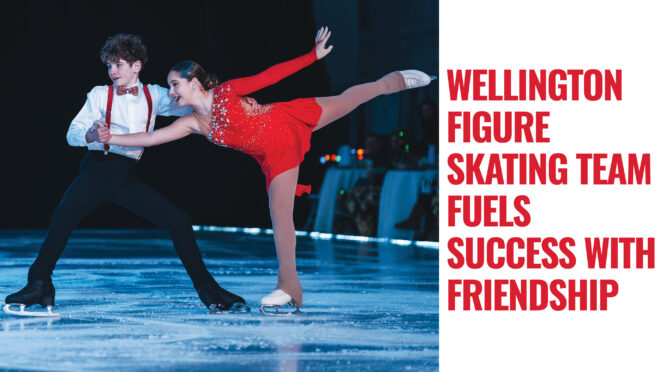
Wellington Figure Skating Team Fuels Success With Friendship
By Patrick Sherry
On less than an inch of sharp blades and in complete unison, Olivia Kotel, 13, and Rylin Reaves, 14, combine high-intensity athleticism with artistry. Their friendship started at the same ice rink while training under the same coaches, and now the two are chasing the same dream to reach figure skating’s biggest competitions together.
The two Wellington teenagers train nearly every day at Palm Beach Skate Zone off Lake Worth Road. Both began their figure skating journeys as young children and have been diligently training ever since.
Kotel and Reaves were already close friends before they began their partnership two years ago.
The two first teamed up for a performance at Skate Zone’s annual holiday show. Recognizing their friendship and chemistry on the ice, their parents and coaches suggested they become a pairs team.
“We’ve always skated together,” Kotel said. “We have the same coaches, so it was just a decision that we made because we did a show one year.”
Pairs skating is one of the most physically demanding and difficult disciplines in figure skating. In it, a male and female skater perform in unison, showcasing synchronicity and athleticism through the execution of complex elements.
Pairs teams incorporate all elements seen in singles skating, like jumps, footwork and spins. Its main differentiator is the inclusion of side-by-side jumps, overhead lifts and throw jumps, in which the male assists the female into the air, allowing her to complete and land a jump.
Before partnering, Reaves admitted that he was initially jealous of Kotel’s skating abilities. While he is hesitant to say whether he has surpassed her yet, they both acknowledge that they have strengths that complement each other. Their combined skills push them to grow and learn together.
“I used to be jealous of her because she was a lot better than me,” Reaves said. “When she was younger, she had a lot higher jumps than me, and I remember there was a good couple-month period where I was jealous of her… But then we became really close. One thing led to another, and we started skating together.”
To transition from singles to pairs skating, they had to learn new elements and how to coordinate their movements, all while being in tune with music.
Kotel and Reaves said the biggest adjustment was learning how to synchronize their skating, especially during side-by-side jumps. Yet, they acclimated quickly to the changes, which they attribute to the similar techniques learned from the same coaches.
Moving as one is now even second nature to them. They’ve developed a natural sense of each other’s movements by relying on visual or audio cues to match timing and complete elements seamlessly.
“When we started, we were very slow and hesitant, and we really didn’t match crossovers or side-by-side moves,” Kotel said. “This year, we have more power in the little in-between things, and we’re more connected. I feel like that makes us stand out compared to other teams.”
Kotel and Reaves participate in multiple individual and pairs competitions across the country each year. As a pairs team, they currently compete as juveniles on the figure skating championship track. During the season, the two participate in U.S. Figure Skating’s National Qualifying Series (NQS), which brings together nearly 1,500 skaters from around the country to compete at multiple qualifying events. The NQS allows skaters to develop their rankings within the sport and serves as one of the pipelines to qualify for the U.S. Figure Skating Championships.
Last year, the team made it to the NQS U.S. Pairs Final. This earned them spots at National Development Camp and on the National Development Team. The camp was a multi-day training program for top-performing skaters in the NQS. It took place around the same time as the U.S. Figure Skating Championships, so young competitive skaters could watch the competition live and train with high-level coaches in a group environment.
The pair explain that becoming a part of the National Development Team is one of the highlights of their competitive careers so far. They added it was a privilege to watch elite figure skaters in competition and learn from world-class coaches.
“It was definitely challenging, learning different views coaches have on certain elements and connecting what our coaches have taught us with what they were saying,” Reaves explained. “It was challenging, but I feel like we got a lot out of it, and it was very fun.”
Kotel and Reaves recently kicked off the NQS competitive season with other skaters from Palm Beach Skate Zone. This year, they will be performing to the song “Hallelujah” that they reworked from last year’s holiday show. They usually perform to upbeat music, but they are excited to take on the challenge because it was a crowd favorite.
This year, they have their sights on reaching the National Development Team Championship competition. As they continue to develop as skaters, they are learning and incorporating more difficult elements while focusing on improving artistry. To help them achieve all this are their parents and coaches, who are supporting them along the way. They describe their coaches almost as second parents because of how much time they spend together.
Jennifer Kane, one of their coaches, believes that their close bond makes Kotel and Reaves a great team.
“Rylin and Olivia are both very strong skaters independently. As a pairs team, they have a very common ground in their skating skills,” Kane said. “They have this natural capability to match each other in their movements and skating style, and their speed and power are equivalent. When they started skating together two years ago, it just seemed so natural.”
The two bring that connection to every competition. Reaves said their friendship motivates them to improve and continue to show their best every time they are on the ice. While figure skating can be full of falls and missteps, this strong relationship makes every competition enjoyable.
“It’s definitely easier doing a competition with somebody else — doing pairs instead of singles,” Kotel said.
Like most young elite athletes, Kotel and Reaves want to reach their sport’s biggest stages. They hope to qualify for the U.S. Figure Skating Championships in the future and eventually compete at the Winter Olympics. To get there, they are going to work hard while maintaining a positive mindset. If they can accomplish these goals, they said they would be proud to represent their hometown and the rink where they train.
“Since this is my first [figure skating] club, and it’s my hometown, if in the future we go really far, it would feel great to represent where I came from,” Reaves said.
Built on friendship and a commitment to growing together, the partnership that Kotel and Reaves have is turning their bond into their competitive advantage. They skate, fall and get up together, and hope they can achieve their dreams side-by-side.
“Don’t let anything that anybody says or any negative results that you see get in your head — and definitely make sure you have good chemistry with your partner,” Reaves said.
To learn more about Olivia Kotel and Rylin Reaves and their exciting figure skating journey, follow them on Instagram @team_rylivia.


