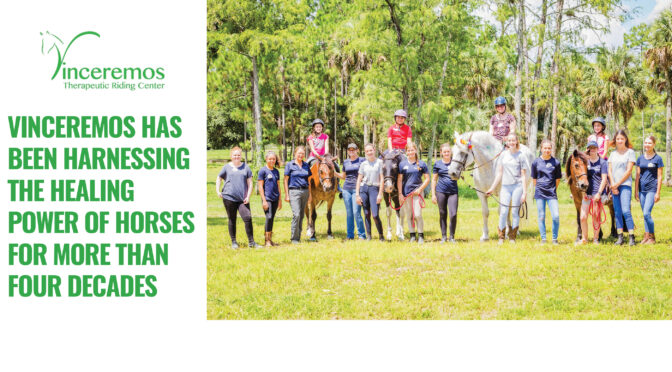
Vinceremos Has Been Harnessing The Healing Power Of Horses For More Than Four Decades
By Fiona Slusarev
From humble backyard roots, the Vinceremos Therapeutic Riding Center has grown exponentially over the past 44 years. Located on 15 acres in Loxahatchee Groves, Vinceremos offers riding and equine-centered programs to children and adults with disabilities, people suffering from mental health conditions and veterans.
The vision of Vinceremos is to “unleash the power of equine therapy,” and that is exactly what this local nonprofit has done on a daily basis since 1982. As a premier accredited center, Vinceremos is subject to the strict administration, facility, program and safety standards of the Professional Association of Therapeutic Horsemanship (PATH) International.
Ruth Menor founded Vinceremos after graduating from Florida State University with a degree in therapeutic recreation.
Growing up on a dairy farm in Michigan, Menor was always around horses. In fact, one of the first centers for therapeutic riding in the United States was in the area, and she started volunteering at an early age. Horses were a support for Menor when her father passed away and her family relocated to Cleveland, Ohio, and later to South Florida.
“It was something that always helped me make transitions in my life. I always joke about the ‘stable’ environment. I had my horse friends: the horses and the human friends that were always connected to the horses,” Menor recalled.
Vinceremos began in the backyard of a friend who saw value in Menor’s vision, and soon the organization outgrew the original location and leased a property in Lake Worth. In 1995, they raised enough money to buy the current property in Loxahatchee Groves.
“We are very fortunate that we are in the Wellington area, where we have so many people who have horses and understand the value of the horse-human interaction, so they immediately get the therapeutic benefits,” Menor explained.
CEO Susan Guinan joined Vinceremos almost 19 years ago when the organization had just two employees. From the original two programs, the adaptive riding and hippotherapy programs, the nonprofit has added equine-assisted learning, equine-assisted psychotherapy and the Freedom Reins program for veterans.
“Inspiration is outside my window every minute of every day,” Guinan said. “Whether that’s the inspiration that comes from watching children in the hippotherapy programs start to build strength, the inspiration that comes when parents see potential that may have been hidden by their [child’s] condition, or inspiration comes from donors who support the programs and see the benefits. There is inspiration behind every corner.”
Today, Vinceremos serves approximately 250 individuals each week. Adaptive riding empowers individuals with disabilities to improve their core strength, coordination and balance, while providing a sense of accomplishment and independence. Lessons are taught by PATH-certified therapeutic riding instructors with skilled volunteers to provide support.
“When you’re doing adaptive riding, you’re learning to ride a horse like anybody else is, but those professionals have a disability education [and] a huge toolbox of different adaptive equipment and adaptive skills in terms of working with individuals with disabilities,” Director of Operations Jessica Rhinelander explained.
Rhinelander, like Menor, grew up volunteering at a therapeutic riding program. She later went on to have a professional dressage career and coach Paralympic athletes. After leaving the horse world for three years and working in a corporate job, she returned to work at Vinceremos and has been a part of the team for nearly four years.
Hippotherapy, like adaptive riding, can help individuals with disabilities like cerebral palsy and autism. Hippotherapy differs from adaptive riding because of the additional therapist — physical, speech or occupational — that joins the therapeutic riding instructor to help the rider reach a therapeutic goal. The movement of the horse’s body mimics the motion of the human pelvis walking, which combined with a therapist’s guidance, helps riders with issues like a traumatic brain injury, stroke or spinal cord injury.
“We have individuals who have come to us and said, ‘Nothing else works: We’ve tried all these other therapies, and this is the only thing that works. And my child loves coming here.’ Everything is designed in a way that it’s a game or an interaction or empowering in some way,” Rhinelander said.
Equine-assisted learning also echoes these same principles. This is an unmounted program that teaches life skills to individuals through interaction with horses. Exceptional student education (ESE) students from Wellington and Palm Beach Central high schools regularly participate in equine-assisted learning and gain experience in teamwork, sequencing, life skills, communication and understanding body language.
“The feedback we get from teachers is, ‘Wow, I didn’t realize how engaged the students would be,’” Rhinelander said.
Students learn about self-care while they groom horses and understand measurements in the feed room as they measure out grain for the horses. Teachers find their students are often better able to self-regulate with this hands-on learning.
Equine-assisted psychotherapy is another unmounted program, which uses the horse as a bridge for individuals to talk about their emotions under the guidance of a licensed mental health professional and an equine specialist. Freedom Reins is a similar program for veterans; a free 10-week program helps empower individuals with post-traumatic stress disorder.
Equine-assisted psychotherapy is beneficial to children and adults who have experienced traumatic events, or for foster and adoptive families experiencing change. The mental health professional works with the equine specialist to develop lesson plans and activities that tackle the individual’s needs and ensure safety around the horse.
Something as simple as watching herd dynamics in a group of horses that are meeting for the first time can be an avenue to discuss bullying. “You can lead the conversation into one of their experiences, but talk about the horses,” Rhinelander explained.
All these therapies are only possible because of the network of devoted volunteers at Vinceremos, many of whom come to the facility with no prior horse experience. Care and consideration are even reflected in the construction of the facility and color-coding of horse supplies, so volunteers can learn as they go. “We are very much a volunteer-centric organization,” Guinan said.
Everyone is learning and growing at Vinceremos. Volunteers leave with horse-care knowledge and a better understanding of individuals with disabilities. “They’re getting to volunteer, but at the same time, they are being introduced to individuals with different abilities, and they start to look beyond the disability and see the human being,” Guinan said.
Many children and adults are able to come to Vinceremos on scholarships because of volunteers giving their time and donors covering horse care and facility costs. They are also now registered with Sunshine Health, so the facility can accept that insurance. “We firmly believe that no one should be turned away because of their inability to pay,” Rhinelander said.
Menor, Guinan and Rhinelander hope that the program will keep expanding, as it has over the last four decades. The search for patient and easygoing horses themselves to serve the needs of specific individuals is also ongoing. The horses have a 90-day trial and numerous activities to complete before committing to Vinceremos.
The 10-person board of directors also hopes to construct an additional facility to better serve the growing clientele base, adding to the existing 24-stall barn and 45,000-square-foot covered arena.
Vinceremos will host a Nashville Songwriters Night fundraiser on Sunday, March 8. Rhinelander was instrumental in creating this fundraiser with Dean Alexander, whose daughter rides in the hippotherapy program. As the second year of the event, supporters are welcomed into the Vinceremos covered arena and treated to dinner and an open bar. They have the opportunity to go into the barn and meet the horses firsthand before the two-hour songwriters’ performance featuring Dean Alexander, Marv Green and Terry McBride.
“What you feel at this event, and what the music makes you feel, is exactly what our clients feel when they come here,” Rhinelander said.
For information and tickets to the event, visit www.eventbrite.com and search for “Nashville Songwriters Night in Support of Vinceremos.”
Vinceremos is located at 13300 6th Court North in Loxahatchee Groves. For more information, call (561) 792-9900 or visit www.vinceremos.org.


