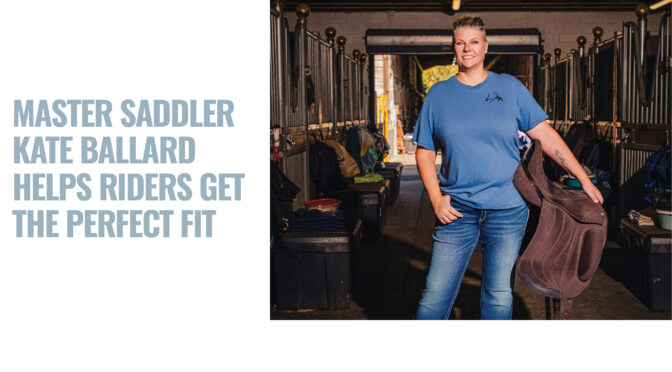
Master Saddler Kate Ballard Helps Riders Get The Perfect Fit
By Fiona Slusarev
For equestrians, no other piece of tack is quite as important as their saddle. It is vital that it fits both rider and horse to prevent injury and allow everyone to perform at their best. However, getting a correctly fitted saddle is a perennial issue for riders across all equestrian disciplines.
Kate Ballard of WestHill & Son Saddlery is one of only two master saddlers registered with Britain’s Society of Master Saddlers working in the United States, and she is the only woman in the country with traditional British qualifications to design and craft bespoke saddles by hand. Starting her training at age 15, she now makes custom tack at her Loxahatchee workshop.
“I’ve wanted to make saddles since I was 11 years old,” Ballard recalled. “I remember writing my French essays at school — they were all about saddle making.”
Ballard apprenticed with a master saddler in Suffolk, England, before training at Cordwainers Technical College in London for three more years. She not only studied saddle making but also learned the biomechanics of horse and rider, the muscular system and skeletal frame of the horse, bridle making, harness making and lorinery. Lorinery is considered a heritage craft in the United Kingdom and consists of making all the metal components used on the horse, including bits, buckles and stirrups.
Her studies at Cordwainers were followed by a four-year apprenticeship with master saddler and harness maker Geoff Dean, for a total of nine years of education. She was requested to create ceremonial saddlery for the King’s Troops, to be presented at the Royal Tournament, Earls Court, London by Princess Anne. Ballard was also chosen for the Prince of Wales Award for Rural Craft and invited to St. James’s Palace to receive the honor from then Prince Charles, now King Charles III.
Ballard came to the United States in 2002 after her highly successful career in England, into a void of professional saddlers. “America is starved for saddlers and saddle fitters. There isn’t anywhere in the United States where you can get the education that I was lucky enough to have,” Ballard said.
That education is what separates her from saddle fitter representatives from the big tack brands, who often only have a few weeks of training.
This is what keeps Ballard fitting three to six horses per day. With her experience in leather crafts, combined with her knowledge of horse and rider physiology, she is able to make truly custom tack to fit niche needs. She even dabbles outside the equestrian sphere with other leather items.
“I’ve done incredibly specific saddles for para-riders, each saddle completely unique to that horse and rider,” she said. “I’ve covered driving shafts in patent leather, made bonnet straps for old classic cars, gun holsters, leather boxes, all sorts of leather goods, and made-to-measure bridles.”
From consulting for the para-dressage Olympic team, to making completely bespoke bridles, Ballard is well versed. She also provides some clarity on the perpetual wool versus foam panel debate. Ballard is unquestioningly in favor of wool, which allows her to easily make adjustments as needed. It is not a question of if the horse changes, she said, it is a question of when the horse changes.
“The only reason foam panels exist is because, when saddles were produced years and years ago for the American market, there weren’t saddlers here to make frequent adjustments. That’s different now,” Ballard explained.
Foam panels mean that the customer has to ship the saddle back to the manufacturer and lose it for weeks at a time while it is completely redone to correct the fit. Ballard, however, can adjust wool flocking in an hour at the stables. Which is important, since saddle fit must be checked “twice a year minimum,” Ballard stressed. “It doesn’t matter if the horse is 3 or 33.”
Corrective padding can be another point of stress for the rider. If the saddle itself isn’t a perfect fit, how can it be corrected? With so many options — half-pads, riser pads, shims, new gel-pads and more — it’s hard to know what is actually going to help the horse. For Ballard, corrective pads are not a final answer:
“There is a time and place for pads; most are absolutely useless. If it’s needed, it’s not a long-term solution,” she said.
When investing in a saddle, riders might be tempted to put their fit above that of their horses. Perhaps a saddle is a perfect fit for you and within budget, but isn’t a complete match for your horse. However, Ballard said, the horse should come first. “The saddle has to fit the horse for maximum performance,” she explained.
While Ballard holds the horse’s fit paramount, she acknowledged that if the saddle is not fit to the rider, some issues, like imbalance, can transfer back to the horse. “The saddle is designed to put you in a certain place, and it can create chaos if it’s incorrect,” she said.
All equestrians know a horse that is “hard to fit.” Perhaps a little too high in the withers, wide at the shoulders or long in the back. Whatever the reason, Ballard hears this complaint all the time. She credits this issue, not to the confirmation of the individual horse, but to industry standards that haven’t kept up with changing sporthorse measurements.
“Over the last 7, 10 even 15 years, breeding has changed horses significantly, affecting back shape, so saddle design needs to evolve alongside those changes,” Ballard explained.
Ballard is also educating professionals in other equestrian fields on the very basics of saddlery. For experts in various horse care careers, such as veterinarians, chiropractors and bodyworkers, understanding and recognizing an incorrectly fit saddle can be a pivotal part in treating an issue.
“We all play a part in these horses’ lives, and if I can help other professionals, it’s ultimately better for the horse,” said Ballard, who offers a one-day class for these professionals, as well as a two-day class for aspiring saddlers. She is not teaching how to fit a saddle in a day, but rather providing insight into understanding the complete picture of the horse.
Even though Ballard has worked fitting saddles for more than 35 years, it seems the job hasn’t gotten old yet. Starting out as a child in pony club, then fox hunting, eventing and show jumping, and now a retiree from riding, she still holds a great deal of admiration for horses and riders.
“I love what I do. I’m addicted to it. I am so lucky to have had the education I had,” Ballard said. “One of the best feelings is seeing the horse and rider connect in harmony because the horse can move uninhibited and the rider can stay in balance.”
For more information about Kate Ballard and WestHill & Son Saddlery, visit www.westhillandson.com.


