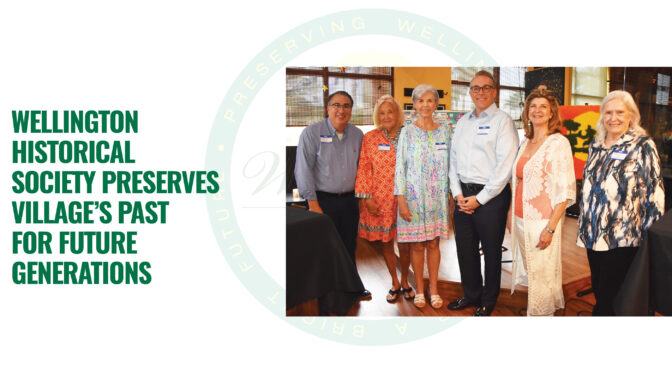
Wellington Historical Society Preserves Village’s Past For Future Generations
By Patrick Sherry
Wellington’s history is written every day by the residents who call it home. Some of the people who helped shape the community in its early days are now gone, while others are still here, but the history they made will not be forgotten because of the Wellington Historical Society.
The Wellington Historical Society was created in 2018 by residents who saw the importance of preserving the community’s past for future generations. To them, a bright future is possible by learning from local history and the people who made it. The organization undertakes this mission by sharing Wellington’s history through the recording of firsthand experiences and the collection of historical documents.
Made up of community leaders and long-time residents, the society understands that the knowledge of history can disappear if no one preserves it. However, remembering yesterday can guide those who want to build toward a greater future.
“Our work helps connect people to the place they live,” explained Sue Bierer, president of the Wellington Historical Society. “Understanding how Wellington developed gives residents a greater appreciation for the vision, determination and community spirit that shaped our village.”
The organization’s collection boasts several historical materials that document Wellington’s early years and its rapid growth. Its members archive these documents online for the community to access. Members also interview long-time residents and local leaders who made Wellington what it is today. Their stories detail their experiences seeing the small community grow into a thriving village that has become one of the most desirable places to live in Florida.
Bierer said that the most meaningful pieces in the organization’s collection are those from events and people that many residents remember, like when Prince Charles and Princess Diana came to Wellington in 1985 or the first meeting of the Wellington Village Council in 1996. Sharing stories that have never been recorded before, or seeing families recognize familiar faces, creates a personal connection to history that reminds people why preserving it matters, she said.
“We focus on collecting and documenting Wellington’s history because today’s memories become tomorrow’s history,” Bierer said. “Our goal is to preserve not only major milestones but also the everyday experiences that define our community.”
Before becoming Wellington, the area was part of a vast wetland connected to the Everglades with few people living here. But over the last 75 years, the once remote swamp was transformed into the prosperous community it is today. Even with its short history, the members of the Wellington Historical Society pride themselves on learning and understanding the place they call home.
“Although Wellington is a relatively young community, many of its founding residents recognized that important stories, photographs and historical materials could easily be lost if they were not collected and preserved,” Bierer said. “The society was created to ensure that those memories would be available for future generations.”
In 1951, accountant Charles Oliver Wellington worked with Arthur William “Bink” Glisson to purchase and assemble the 18,000 acres of land that would become Wellington’s namesake community. He named the property south of Southern Blvd. and west of State Road 7 as the “Flying COW Ranch,” with COW standing for his initials.
Shortly thereafter, state lawmakers created the Acme Drainage District on the land acquired by Wellington to provide drainage and flood control. The area was subsequently turned into agricultural land that was sold and leased to farmers. At one point, more than 2,000 acres were strawberry fields, and it was believed to be one of the largest strawberry patches in the world.
“The stories of Charles Oliver Wellington and Bink Glisson are fascinating chapters in our community’s history,” Bierer said.
When Charles Oliver Wellington died in 1959, it would take a couple more decades for the property to begin its transition to the community we know today. The decision to develop part of the land was made by Wellington’s son, Roger Wellington.
The Investment Corporation of Florida (ICOF) partnered with the Alcoa Corporation to begin the first major residential development of Wellington after it purchased 7,400 acres of the land in 1971. Rapid development followed as the population of the community continued to grow. In 1995, residents voted to establish the Village of Wellington as a municipality.
Wellington Historical Society members work to ensure that children who grow up in Wellington learn about this history. Bierer and a team of retired teachers created a curriculum that teaches elementary school students about the history of the community they live in. Schools across Wellington use the curriculum during social studies classes to celebrate the achievements of the village.
Throughout the year, the Wellington Historical Society also hosts educational programs, lectures and social events to make the village’s history accessible to everyone in the community.
“We’ve received tremendous encouragement from residents who appreciate having a place where Wellington’s history is preserved and celebrated,” Bierer said. “Many people are excited to contribute their own photographs and memories once they learn about our mission.”
Bierer said that Wellington is important to residents, so preserving and honoring the past is a meaningful way that they can ensure it will never be forgotten.
“It has been one of the most rewarding experiences of my life,” she explained. “I’ve met wonderful people, learned so much about Wellington’s remarkable history, and had the privilege of helping preserve the story of a community that means so much to so many people.”
Wellington started with less than 100 people decades ago and has since grown to a population of more than 62,000. Many early residents are still alive today, and their descendants are the future of the community. A photograph or memory is not just a keepsake, but part of the story of the resilient, passionate people who contributed to making their community.
The Wellington Historical Society prides itself on recording those stories so it can be preserved in the unique history of the village for future generations, so they can continue the village’s legacy.
“Every community has a story worth telling,” Bierer said. “Local history reminds us where we came from, celebrates the people who built our community, and provides valuable lessons for future generations. If we don’t preserve these stories today, they may be lost forever.”
To learn more about the Wellington Historical Society, access its online archives, or donate to its fundraising initiatives, visit www.wellingtonhistoricalsociety.org.


