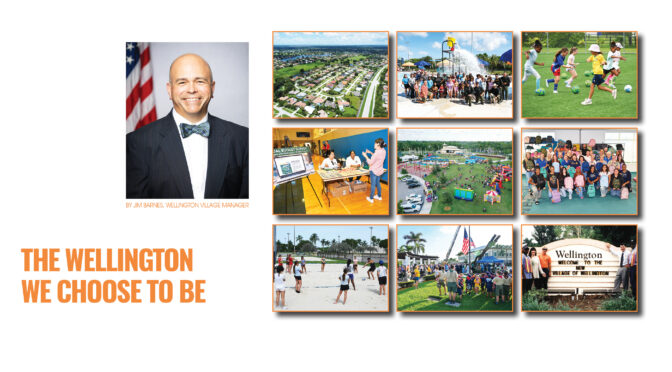
The Wellington We Choose To Be
Thirty years ago, Wellington’s residents chose to build a community of their own. Twenty-five years ago, our nation was reminded in the most painful way possible how much communities depend upon one another. Today, we have the privilege, and the responsibility, of learning from both.
Thirty years is a long time. For some residents, Wellington’s incorporation is something they remember. For others, Wellington has been home their entire lives. And for many newer residents, the community they moved to may seem as though it has always been here. But Wellington was not inevitable. Thirty years ago, a group of residents made a decision that they wanted their community’s future to be shaped locally. They believed local government should be close to the people it serves, and that Wellington’s unique character and quality of life were worth protecting. That decision created the village we know today.
This September, as we continue to celebrate Wellington’s 30th anniversary year, we also pause to mark another anniversary, one that has nothing to do with budgets, development or local government, but has everything to do with community. Twenty-five years ago, on Sept. 11, 2001, our country changed forever. The events of that day reminded our entire nation of something fundamental: communities are more than the places where we live. They are the people we stand beside. They are the first responders who run toward danger when others are running away. They are the neighbors who check on one another. They are the volunteers who step forward when they are needed. They are the people who, in difficult moments, put aside their differences and ask a simple question: How can I help?
Twenty-five years later, those lessons remain important. And as I think about Wellington’s first 30 years of incorporation, I believe they are connected to the story we are writing for the next 30. Because communities are living things. They grow. They change. New families arrive. Businesses open. Roads are improved. Parks evolve. New neighborhoods are built. Technology changes how we work and communicate. The expectations residents have of their local government change, too.
Our responsibility is not to freeze Wellington in time. Our responsibility is to make sure that as Wellington changes, we remain intentional about what should never change. We should continue to be a community that values its open spaces, parks, trails, equestrian heritage, neighborhoods and sense of place. We should continue investing in infrastructure that supports our residents today while preparing for the demands of tomorrow. We should continue creating places where people want to gather — not simply places where people pass through.
And we should continue to be a community where neighbors know that their voices matter. That last point may be the most important. Local government works best when it is a conversation, not one-way communication. Over the past several years, we have made it a priority to make village government more accessible and more personal. That includes sharing information more openly, communicating directly with residents through social media and other platforms, and looking for more opportunities to explain not only what we are doing, but why we are doing it.
Our residents should not have to attend a council meeting to understand what is happening in their community. At the same time, government should not assume that communicating means we have done our job. We also need to listen, and Wellington residents have certainly demonstrated that they are willing to engage. We see it during the budget process. We see it when development proposals come forward. We see it when residents advocate for their neighborhoods, parks, roads, schools and community institutions. We see it at village events and community meetings.
Sometimes that engagement leads to agreement. Sometimes it doesn’t. But that is what a healthy community looks like. We don’t have to agree on everything to care deeply about the same place. One of the things I have learned during my 23 years with Wellington is that community character is not created by a single comprehensive plan, ordinance or development project. It is created by thousands of decisions, large and small, made over many years.
It is created by the resident who volunteers. The coach who gives their time to young athletes. The business owner who invests in the community. The neighbor who looks out for someone down the street. The employee who takes pride in serving the public. The parent who brings their child to a village program. The senior who participates in a community activity.
And it is created by the men and women who choose public service, whether they are elected officials, village team members, law enforcement officers, firefighters, teachers, healthcare workers or any of the countless others who serve their neighbors every day. September gives us a reason to remember that. Twenty-five years after Sept. 11, 2001, we should remember not only the tragedy and the lives that were lost, but also the extraordinary sense of unity and service that emerged in its aftermath.
We should remember the courage of those who responded. We should remember the generosity of strangers. We should remember that, when faced with something larger than ourselves, Americans came together. And perhaps most importantly, we should remember that the strength of our country ultimately rests on the strength of our communities.
That is something worth carrying forward. As we look toward Wellington’s next 30 years, we will face difficult choices. Wellington will continue to grow and evolve. There will be proposals we support, proposals we oppose and proposals that require compromise. There will be competing demands for limited resources. There will be new technologies and new ways of delivering services. There will be challenges we cannot yet anticipate.
Our job is not to predict all of them. Our job is to be prepared for them. That means continuing to plan ahead. It means maintaining the financial discipline that allows us to invest in our community. It means protecting the infrastructure and public spaces that define our quality of life. It means being willing to embrace new ideas while remembering the values that brought us here in the first place. And it means continuing to listen to the people who call Wellington home.
Thirty years ago, Wellington’s residents chose to build a community of their own. Twenty-five years ago, our nation was reminded in the most painful way possible how much communities depend upon one another. Today, we have the privilege, and the responsibility, of learning from both. Not with one grand decision, but through the thousands of decisions we will make together over the next decade and beyond.
The Wellington of tomorrow is being built today. And ultimately, the question is not simply what Wellington will become. The question is, what kind of Wellington do we choose to be? I believe the answer should be a community that continues to grow without losing its identity; that embraces the future without forgetting its past; that welcomes new residents while maintaining the sense of community that brought so many of us here; and that remains committed to service, compassion, courage and looking out for one another.
Thirty years ago, Wellington’s residents chose to build a community of their own. Twenty-five years ago, our nation showed the world what community could mean in the face of tragedy. Our responsibility now is to make sure that the next 30 years are worthy of what they started, and that we never forget the people and principles that made both stories possible.


